

Disclosure: This post contains Amazon affiliate links. As an Amazon Associate, SkinCare Lab earns from qualifying purchases at no extra cost to you.
Note: This is general skincare information, not medical advice. If you have a skin condition, are pregnant, or are unsure about a product, talk to a dermatologist or healthcare professional before starting it.
Quick Answer
Vitamin C serum can brighten skin, fade dark spots, support collagen, and help protect against sun and pollution damage. Apply 3-4 drops every morning after cleansing and before moisturiser and SPF. A 10-15% formula is a good starting point for most people. Look for L-ascorbic acid with ferulic acid and vitamin E, or a gentler derivative if your skin is sensitive. Most people see visible brightness in 2-4 weeks, and dark spots start to fade in 4-8 weeks, with daily use and SPF.
What Is Vitamin C Serum?
Vitamin C serums deliver concentrated vitamin C directly to the skin. The most studied form is L-ascorbic acid. Gentler derivatives are also used in many products. As an antioxidant, vitamin C helps neutralise free radicals, supports collagen production, and helps slow melanin production. Those three actions explain why it is used for dullness, dark spots, and fine lines. Its main weakness is instability. L-ascorbic acid can oxidise quickly when exposed to light and air. It can turn from pale yellow to brown and lose strength. That is why packaging and storage matter so much. See the Storage and Oxidation section below.
12 Vitamin C Serum for Face Benefits
1. Brightens Dull Skin
Vitamin C helps slow tyrosinase, the enzyme involved in melanin production. Many people notice a brighter, more even look within 2-4 weeks of daily use.
2. Fades Hyperpigmentation and Dark Spots
It can help reduce post-acne marks, sun spots, and age spots by limiting new melanin and supporting even tone. For a full dark spot routine, see our guide on how to remove dark spots naturally. Typical timeline: 4-8 weeks for early fading. Deeper spots can take 8-12 weeks or longer.
3. Boosts Collagen Production
Vitamin C is needed for collagen synthesis. Topical vitamin C can support firmer-looking skin over time. This is a slow benefit. Expect 8-12 weeks before firmness changes are easy to see.
4. Protects Against Sun Damage
Vitamin C helps neutralise UV-generated free radicals that SPF alone does not stop. Used under sunscreen in the morning, it adds a second layer of daytime protection. It does not replace sunscreen.
5. Reduces the Look of Wrinkles and Fine Lines
New collagen can plump and smooth the look of existing lines over time, while antioxidant protection helps limit new damage from UV and pollution. For a complete anti-ageing plan, see our anti-ageing home remedies guide.
6. Speeds Wound Healing and Scar Fading
Vitamin C supports tissue repair and can help fade post-acne marks after a spot has healed. Do not apply it to open or broken skin. Wait until the skin has closed. See our full acne scars treatment guide.
7. Evens Skin Texture
With regular use, skin can look smoother and more even. Pores may look smaller because the skin around them looks healthier and more even-toned. Makeup also tends to sit better on smooth, hydrated skin.
8. Reduces Redness and Inflammation
Vitamin C has anti-inflammatory action, and some people with reactive skin find it calming. It does not suit everyone with redness or rosacea. If you have rosacea, eczema, or very reactive skin, patch test first and choose a gentle derivative at a low concentration.
9. Hydrates and Plumps Skin
Vitamin C can help reduce water loss and support a healthy moisture barrier. It pairs well with hyaluronic acid. Apply vitamin C first, then hyaluronic acid on top for extra hydration.
10. Protects Against Pollution
As a free radical scavenger, vitamin C helps defend against environmental stress from pollution, ozone, and smoke. This is useful for daily city skin, not only in summer.
11. Brightens Under-Eye Dark Circles
It can help lighten pigmentation-based darkness under the eyes and support the delicate skin there. Apply a small amount gently with your ring finger. Avoid getting it in your eyes. Visible change, if it happens, usually takes 4-6 weeks. Dark circles caused mainly by thin skin, veins, or lack of sleep may not change much.
12. Works for Most Skin Types — With Care
Oily, dry, combination, mature, and acne-prone skin can all benefit. Sensitive skin should start with 5-10% or a gentler derivative and build up slowly. Very sensitive or reactive skin, active eczema, and broken skin need extra care. Patch test first. If stinging, redness, or peeling lasts more than a few minutes or gets worse over days, stop and try a lower concentration or a different form.
How to Use Vitamin C Serum Correctly
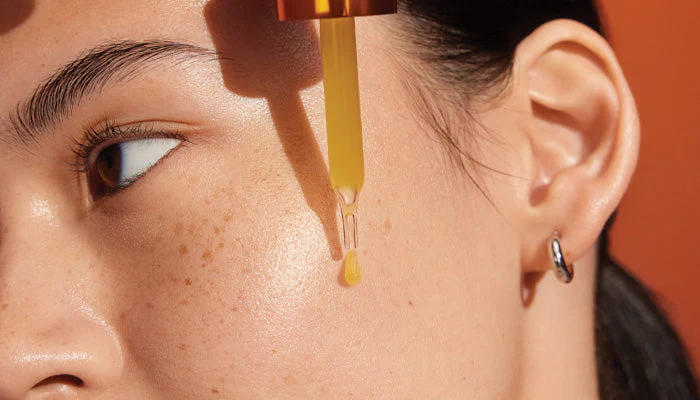
Step-by-step: Cleanse, pat skin dry, apply 3-4 drops of vitamin C serum, pat gently into face and neck, wait 1-2 minutes, moisturiser, SPF in the morning.
Best time: Morning is a good default, because vitamin C works with sunscreen during the day. Evening use also works for scar fading and collagen support. You can use it once or twice a day if your skin tolerates it. Start once a day.
How much: 3-4 drops is enough for face and neck. More product does not give faster results. It only raises the chance of irritation.
Patch test: Apply a small amount to your jawline or behind your ear once a day for 3-5 days before full-face use. If you get lasting redness, itching, or breakouts, stop.
For the wider routine this fits into, see our guide on how to get glowing skin naturally at home. Vitamin C is step 9 in that 15-step guide.
Best Concentration for Your Skin
Beginners and sensitive skin: 5-10%, effective with lower irritation risk.
Regular use: 10-15%, a good balance of results and tolerance for most people.
Experienced users: 15-20%, for stubborn pigmentation, if your skin already tolerates 10-15% well.
Higher is not always better. Above 20%, irritation often rises without a clear extra benefit.
Which Form of Vitamin C Should You Choose?
Not all vitamin C is the same. L-ascorbic acid is the most studied, but it is also the least stable and most likely to irritate. Derivatives are gentler and more stable, but they may work more slowly.
If L-ascorbic acid stings or causes redness, try SAP, MAP, or THD Ascorbate instead of giving up on vitamin C completely.
| Form | Best for | Stability | Irritation risk |
|---|---|---|---|
| L-Ascorbic Acid (L-AA) | Dark spots, dullness, anti-ageing, when you want the most studied form | Low, oxidises fast in light and air | Higher, especially at 15-20% or low pH |
| Sodium Ascorbyl Phosphate (SAP) | Acne-prone and sensitive skin, daily use | Higher, more stable than L-AA | Lower |
| Magnesium Ascorbyl Phosphate (MAP) | Dry and sensitive skin, hydration and brightening | Higher, more stable than L-AA | Lower |
| Tetrahexyldecyl Ascorbate (THD Ascorbate) | Sensitive and dry skin, people who cannot tolerate L-AA | Higher, oil-soluble and stable | Lower |
How to Choose a Quality Vitamin C Serum
Look for: L-ascorbic acid or a proven stable derivative, at 5-20% depending on your skin; pH 3.5 or below for L-ascorbic acid to work well (derivatives work at a higher, gentler pH); dark or opaque, airtight packaging; ferulic acid and vitamin E in the formula, which help stabilise vitamin C; no strong fragrance, if your skin is sensitive.
Avoid clear bottles, serums that have already turned yellow-brown, and products with no expiry or opening date on the label.
Storage and Oxidation: How to Tell If Your Serum Has Gone Bad
Vitamin C serums do not last forever, especially L-ascorbic acid formulas.
Signs it has gone bad: Colour has changed from clear or pale yellow to dark yellow, orange, or brown; smell has turned sour, metallic, or unusual; texture feels thicker, sticky, or different from when you opened it; it starts to sting or irritate skin that used to tolerate it.
How to store it: Keep it in a dark or opaque, airtight bottle; store in a cool, dark place, away from sunlight and heat; keep the lid closed tightly after each use; do not store it in a hot, steamy bathroom if you can avoid it. A bedroom drawer or fridge door is often better.
Shelf life: Most L-ascorbic acid serums are best within 3 months after opening. Check the label for the period-after-opening symbol. Unopened, most last up to 12 months if stored well. Check the expiry date. Derivative-based serums often last longer, but the same colour and smell checks still apply.
When to throw it away: If it has turned brown, smells off, or irritates your skin, stop using it. An oxidised serum is unlikely to help and is more likely to irritate. Do not try to rescue it by mixing it with other products.
DIY Vitamin C Serum at Home — Optional, With Safety Notes
A homemade serum is not equal to a commercial serum. Commercial products control pH, stability, and concentration. A DIY mix cannot do that reliably.
Safety box — read before you try this: Patch test first. Apply a small amount to your jawline for 3-5 days before full-face use. L-ascorbic acid powder is acidic. A DIY mix can irritate, sting, or damage the skin barrier if the pH is too low or the concentration is too high. Sensitive skin, rosacea-prone skin, eczema, and broken skin should skip the DIY version. Use a gentle commercial derivative instead. Store in a dark dropper bottle in the fridge. Discard in 1-2 weeks, or sooner if it turns yellow-brown. Stop if stinging lasts more than a few minutes, or if you get redness, peeling, or breakouts.
Basic recipe (only if you accept the risks above): Mix 1/2 tsp L-ascorbic acid powder + 1 tbsp distilled water + 1/4 tsp vegetable glycerin in a dark dropper bottle. Shake well, store in the fridge, use within 1-2 weeks. This gives a fresh, active mix for a short time, but it is less stable and less predictable than a tested commercial serum. For most people, a commercial serum is the safer choice.
Safe Combinations With Other Actives
Good pairs: Hyaluronic acid — apply after vitamin C for extra hydration; Vitamin E — works with vitamin C as an antioxidant pair; Ferulic acid — helps stabilise vitamin C; Niacinamide — can be used in the same routine, see FAQ below; SPF — use every morning with vitamin C.
Use separately: Retinol — use vitamin C in the morning and retinol at night to limit irritation; AHA / BHA — use at a different time of day, as strong acids can irritate skin when layered with L-ascorbic acid; Benzoyl peroxide — can deactivate vitamin C. Do not layer them at the same time.
When in doubt, introduce one active at a time and wait 2 weeks before adding the next.
5 Mistakes to Avoid
- Starting too strong, too fast. Do not start at 20% L-ascorbic acid twice a day. Start at 5-10% once a day, then build up over 2-3 weeks.
- Skipping SPF. Vitamin C helps protect skin, but it is not sunscreen. Without SPF, UV damage can undo the brightening work. Use SPF 30 or higher every morning.
- Using an oxidised serum. A brown, old serum is not stronger. It is weaker and more irritating. Check colour and smell, and replace it when it changes.
- Mixing it with benzoyl peroxide or strong acids at the same time. Layering can cause irritation or reduce how well vitamin C works. Separate them by time of day.
- Expecting overnight results, then quitting. Vitamin C works slowly. Many people stop after 1-2 weeks because they see no change. Give it at least 4-8 weeks of daily use before you judge it, and take a photo in the same light to compare.
Timeline for Vitamin C Results
First few days: Skin may look slightly brighter after moisturiser and SPF, but this is not a lasting change from vitamin C alone. Mild tingling is common with L-ascorbic acid and should fade in a few minutes.
2-4 weeks: Overall brightness and tone often start to improve.
4-8 weeks: Dark spots and hyperpigmentation often start to fade.
8-12 weeks: Firmer texture and more even tone are easier to see.
12+ weeks: The clearest anti-ageing and tone changes appear with steady daily use.
Consistency for 3 months matters more than a high concentration for 2 weeks.
Frequently Asked Questions
Can I use vitamin C serum every day?
Yes, daily use is common and suits most skin types. Morning use is a good default. Sensitive skin should start every other day and build to daily over 2-3 weeks if there is no lasting irritation.
Should I use vitamin C in the morning or at night?
Morning is best for daytime antioxidant protection with SPF. Evening use also works for collagen support and dark spot fading. Twice-daily use is fine only if your skin tolerates it well.
Can vitamin C serum remove dark spots?
It can help fade dark spots by slowing new melanin production and supporting even tone. It works best with daily SPF, because sun exposure can darken spots again. Many people see early fading in 4-8 weeks. Deeper spots can take 8-12 weeks or longer.
Does vitamin C serum lighten skin?
It brightens and evens tone by reducing excess pigmentation. It does not bleach or change your natural skin colour. The result is a more even complexion, not lighter skin overall.
Can I use vitamin C with retinol?
Yes, but at different times. Use vitamin C in the morning with SPF, and retinol at night. Using both at the same time can cause irritation and reduce how well each works.
Can I use vitamin C with niacinamide?
Yes. Niacinamide and vitamin C can be used in the same routine. Older advice said to avoid them together, but modern formulas are usually stable together. If your skin is sensitive, use vitamin C in the morning and niacinamide at night, or use them on alternate days until you know how your skin reacts.
Does vitamin C cause purging or tingling?
Vitamin C does not usually cause purging like retinoids or strong exfoliants. Mild tingling for a few minutes is common with L-ascorbic acid, especially at higher concentrations. If tingling lasts, or you get redness, burning, peeling, or new breakouts that do not settle in a few days, stop and switch to a lower concentration or a gentler derivative.
Is vitamin C serum safe in pregnancy?
Topical vitamin C is generally considered low risk in pregnancy, and many people continue using it. This is not medical advice for your situation. Talk to your doctor or dermatologist before starting or continuing any active skincare product in pregnancy, especially if you are using other actives at the same time.
Conclusion
Vitamin C serum for face benefits are real, but they are gradual. It can brighten skin, fade dark spots, support collagen, and add daytime antioxidant protection — if you use it daily, protect it from oxidation, and pair it with SPF. Start with a 10-15% formula, or 5-10% if your skin is sensitive. Use 3-4 drops every morning. Give it at least 8-12 weeks before you judge the result.
For the wider glow routine, start with our guide on how to get glowing skin naturally at home. For dark spots, pair this guide with our dark spots guide. For overnight care, see our vitamin E guide.
Related Reads
- Vitamin E for Face: 10 Benefits and How to Use Overnight
- How to Remove Dark Spots on Face Naturally
- 12 Anti Aging Home Remedies for Wrinkles
- Acne Scars Treatment at Home: Natural Remedies
- How to Get Glowing Skin Naturally at Home: 15 Secrets
